POAS Bidding and Why It Outperforms ROAS for eCommerce Growth
TL:DR
ROAS measures total revenue but ignores the actual profit margins of your products.
Relying purely on ROAS can misdirect your ad budget toward high-revenue, low-margin items.
POAS fixes this by swapping the bidding signal from revenue to actual profit.
This approach allows the algorithm to bid more aggressively on your most profitable products.
Setting up POAS requires passing product-level margin data into Google Ads.
POAS is highly recommended for scaling eCommerce brands with varied margins across their catalogues.
Foreword
Most paid media accounts are built around ROAS, and on the surface that seems reasonable. Return on Ad Spend is easy to understand, straightforward to report on, and widely accepted as the benchmark for Google Ads performance. The problem is that ROAS was designed to measure revenue, and revenue without margin context tells you very little about whether your advertising is actually working for your business.
This is the gap that POAS bidding was built to close, and for growing eCommerce brands with varied product catalogues, addressing it can fundamentally change how profitably you scale.
The Flaw at the Heart of ROAS
The core issue with ROAS isn't that the metric is wrong, it's that it's incomplete. Because it measures revenue rather than profit, it treats every pound of income as equally valuable regardless of what it cost to generate.
Consider two products in your catalogue, both priced at £120:
Product A costs £18 to source and fulfil, leaving a gross margin of 85%
Product B costs £90 to source and fulfil, leaving a gross margin of just 25%
Under ROAS, Google bids on both with equal enthusiasm because both generate the same revenue. The fact that Product A is worth more than three times as much to your business is invisible to the algorithm. Over time, budget drifts towards high-revenue, low-margin lines, high-margin products get underinvested, and headline ROAS figures look healthy while actual profit performance disappoints.
ROAS tells you how much you sold. It doesn't tell you how much you made.
What POAS Does Differently
Profit on Ad Spend swaps the signal driving your bidding from revenue to profit. The formula is straightforward:
POAS = Gross Profit Generated ÷ Ad Spend For example: £5,000 gross profit from £1,250 in ad spend = a POAS of 4.0
By passing product-level margin data into Google's Smart Bidding algorithm, your campaigns learn which conversions are genuinely worth pursuing. Higher-margin products attract stronger bids, lower-margin products are naturally pulled back, and your ad spend begins operating in alignment with your P&L. POAS can also factor in fulfillment costs, return rates, and other margin variables, making it a genuine reflection of your business economics rather than a simplified proxy for them.
What This Means When You're Scaling
Scaling ad spend under ROAS carries a fundamental uncertainty, as more budget alone doesn't tell you whether you're generating profitable growth or simply inflating revenue with poor-margin sales. POAS removes that ambiguity. When your POAS target is being met, you know each additional pound of spend is returning profitable value.
It also changes what happens at the lower end of your catalogue:
Products that convert well but generate minimal margin stop attracting spend
Budget is freed up to flow towards your highest-margin lines
Account-level profitability improves without needing to reduce overall conversion volume
How POAS Is Implemented in Practice
Making POAS work requires passing profit data to Google Ads as a custom conversion value in place of the standard revenue figure. There are three main approaches:
Dynamic Margin Feeds
Product-level COGS data calculates the gross profit value of each conversion in real time, giving Google the most accurate signal to optimise against.
Margin Tier Grouping
Products are grouped into margin bands and assigned a representative profit multiplier, making it a practical starting point for businesses without granular COGS data readily available.
Server-Side Conversion Logic
Profit values are calculated using live cost and margin data before being sent to Google, which is the most precise and scalable approach for businesses with complex pricing or high conversion volumes.
A few things worth knowing before getting started:
Around 30 to 50 conversions per campaign per month is a reasonable baseline for Smart Bidding to function well
Running POAS and ROAS reporting in parallel during transition is strongly recommended, giving you a direct benchmark before fully committing
Revenue may adjust in the short term if budget has historically been weighted towards high-revenue, low-margin products, and it's worth noting this is the intended outcome rather than a cause for concern
Is POAS the Right Move for Your Business?
POAS delivers the greatest impact where there is real margin complexity to work with. If your margins vary significantly across your product range, if your highest-revenue products aren't necessarily your most profitable ones to sell, or if your ad spend is scaling but profit growth isn't keeping pace, then POAS is likely worth a serious look. The same applies if your current Google Ads KPIs feel disconnected from the financial outcomes your business actually cares about.
It's particularly well-suited to retailers operating in competitive verticals, where aggressive bidding can quietly erode margin over time without it ever showing up in your ROAS figures. If you're managing a large or diverse catalogue where the idea of adjusting bids manually at product level simply isn't viable, POAS gives you a smarter, more scalable way to ensure your spend is always working in the right direction.
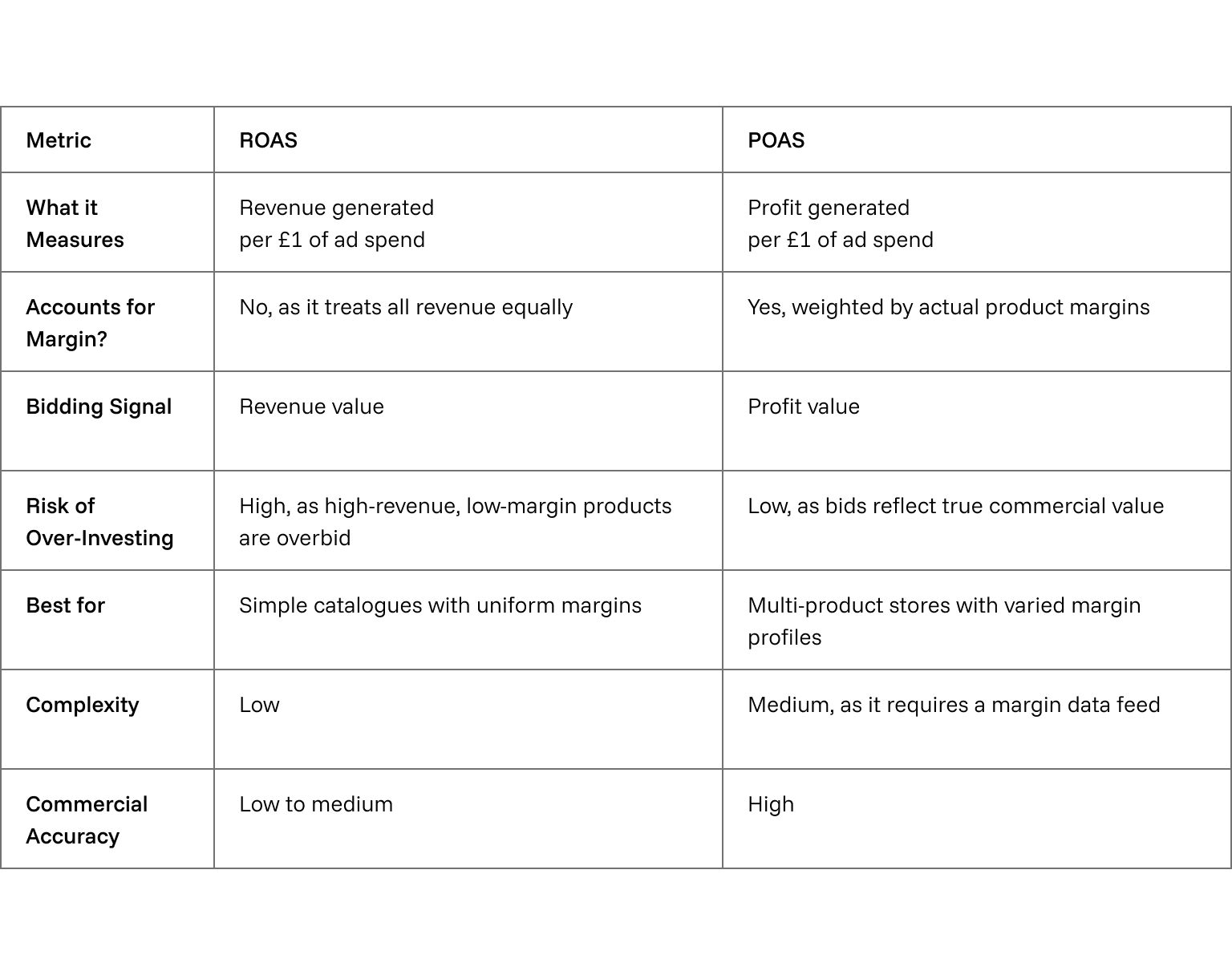
ROAS vs POAS at a Glance
Commonly Asked Questions About POAS
Do we need a large volume of data before POAS becomes viable?
Not necessarily, but having clean, reliable margin data at product level is more important than sheer volume. In terms of conversion activity, Smart Bidding generally needs sufficient signal to learn effectively, and most campaigns with a reasonable level of monthly conversions will meet that threshold without difficulty. For brands already working with a well-structured product feed, the starting point is closer than it might seem.
What happens to our existing ROAS reporting when we switch?
It doesn't have to disappear. Keeping both metrics running alongside each other during the transition period is a sensible approach, as it allows you to compare performance under both frameworks and build a clear picture of how POAS is influencing your results before making it your sole measure of success.
Our revenue numbers are strong. Does that mean POAS isn't relevant for us?
Strong revenue and strong profitability aren't always the same thing, and this is precisely where POAS tends to surface the most insight. If your margins differ across your catalogue, there's a reasonable chance that some of that revenue is being generated at a cost that doesn't serve your business as well as it should. POAS helps identify where that's happening and corrects the balance.
How much disruption does moving to POAS actually involve?
For businesses with accessible margin data and a well-maintained product feed, the transition is manageable and the groundwork involved is worthwhile in its own right. It encourages a level of data organisation and financial clarity that benefits the wider business beyond just your Google Ads account. Where margin data is harder to access, some initial preparation is needed, but this is rarely a blocker for brands already operating with a degree of commercial rigour.
Ready to Make Your Ad Spend Work Harder?
If your Google Ads account is generating strong revenue figures but not the profit margins your business needs, POAS bidding is a conversation worth having. It aligns your advertising investment with the metrics that actually matter and gives you a framework to scale with clarity rather than guesswork.
At Ayko, we work with eCommerce brands to build and implement POAS strategies that reflect the real complexity of their catalogues and cost structures. Get in touch to arrange a free POAS readiness review and find out whether it's the right next step for your account.
By clicking "Accept all cookies", you agree to storing cookies on your device to enhance site navigation, analyse site usage and assist in our marketing efforts as outlined in our privacy policy.
By clicking 'Accept all cookies', you agree to storing cookies on your device to enhance site navigation, analyze site usage and assist in our marketing efforts as outlined in our privacy policy.